
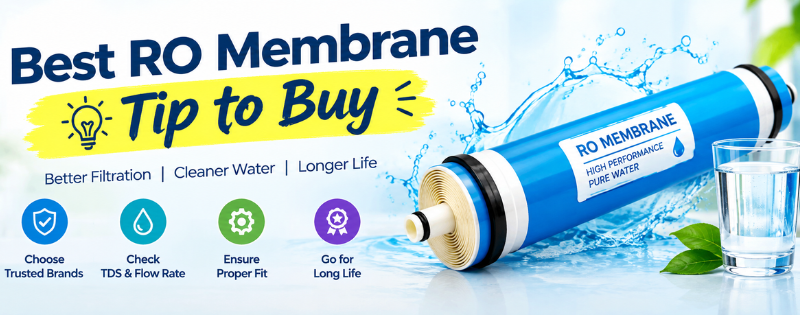
First we would like to tell yu about Reverse Osmosis RO Membrane
The RO (Reverse Osmosis) membrane is the primary filtration engine of any domestic water purifier. While sediment and carbon filters block physical dirt and chlorine, the semi-permeable membrane removes heavy metals (arsenic, lead, fluoride), micro-plastics, and dissolved salts (TDS) down to 0.0001 microns.
If your purified water has developed a sour taste, reduced to a slow drip, or shows rising readings on your TDS meter, your membrane has reached its end of life. To help you select an authentic, long-lasting replacement, we tested and analyzed the best RO membranes in India for both high-TDS borewell water and municipal supplies.
Quick Comparison: Best RO Membranes in India (Price & Specs)
Compare verified replacement membranes based on filtration capacity, salt rejection efficiency, and direct store pricing:
| Brand / Model | Capacity | Salt Rejection | Max Input TDS | Price & Purchase |
|---|---|---|---|---|
| REYGH 80 GPD Membrane | 80 GPD | 97% | Up to 2,000 – 2,500 ppm | Check Price on Gobuyro |
| Konvio Neer 80 GPD Membrane | 80 GPD | 96% | Up to 2,500 ppm | Check Price on Amazon |
| Zedtech 110 GPD Hi-TDS | 110 GPD | 98% | Up to 4,000 ppm | Check Price on Gobuyro |
| Magnite 100 GPD 16-Layer | 100 GPD | 97% | Up to 2,500 ppm | Check Price on Gobuyro |
| Vontron ULP1812-75 | 75 GPD | 96% | Up to 1,500 ppm | ₹750 – ₹950 |
| Saras Waterite 80 GPD | 80 GPD | 96% | Up to 2,500 ppm | Check Price on Gobuyro |
| KENT Sealed Membrane | 75 GPD | 95% | Up to 1,500 ppm | ₹1,800 – ₹2,200 |
In-Depth Reviews: Best RO Membranes in India
1. REYGH 80 GPD RO Membrane – Best for High TDS Indian Groundwater
The REYGH 80 GPD RO Membrane is custom-engineered for harsh Indian water conditions where borewell hardness causes rapid filter chokes. Utilizing high-density composite polyamide sheets, it maintains exceptional salt separation stability and clear water output.
- Capacity: 80 GPD (high permeate flow rate up to 15 L/hr).
- Feed Water Limit: Handles raw groundwater up to 2,500 ppm TDS.
- Salt Rejection: ~97% stabilized salt reduction.
- Pros: Built specifically to prevent premature scaling; universal fit for standard 1812 domestic housings; verified factory testing.
- Cons: Needs regular inline sediment and carbon changes every 3–6 months to maximize its multi-year life.
- Recommended FR: FR-450 or FR-550.
2. Konvio Neer 80 GPD RO Membrane – Popular Amazon Bestseller
The Konvio Neer 80 GPD Membrane is one of the most widely reviewed replacement filters on Amazon India. It offers a solid balance of budget pricing and reliable performance for domestic households.
- Capacity: 80 GPD.
- Feed Water Limit: Effective up to 2,500 ppm TDS.
- Salt Rejection: 95% to 96%.
- Pros: Compatible with almost all domestic water purifiers (Kent, Aquaguard, Livpure, DIY assemblies); dry-packed for long shelf stability.
- Cons: Rejection efficiency can decline slightly during lower pressure fluctuations in winter.
- Recommended FR: FR-450.
3. Zedtech 110 GPD Hi-TDS Membrane – Best for Heavy Borewell & Tanker Water
If your water source is deep groundwater or tanker supply where TDS regularly crosses 2,500 to 3,500 ppm, standard 75 GPD filters choke quickly. The Zedtech 110 GPD Hi-TDS membrane uses heavy-gauge dense sheets designed to resist rapid mineral scaling while delivering higher permeate output.
- Capacity: 110 GPD (rapid tank refill).
- Feed Water Limit: Operates efficiently up to 4,000 ppm TDS.
- Pros: Specially built for hard groundwater; superior scaling resistance.
- Cons: Requires a reliable 100 GPD or 125 GPD booster pump for optimal performance.
- Recommended FR: FR-550 or FR-650.
4. Magnite 100 GPD 16-Layer Membrane – Best Performance per Rupee
The Magnite 100 GPD membrane features a 16-layer polyamide structure that balances filtration quality with budget-friendly maintenance. It fits all universal 1812/2012 domestic membrane housings.
- Micron Rating: 0.0001 microns.
- Feed Water Limit: Effective up to 2,500 ppm TDS.
- Pros: Fast flow rate; high water recovery for large families.
- Cons: Requires regular pre-filter changes every 3–4 months.
- Recommended FR: FR-450 or FR-550.
5. Vontron ULP1812 Series – Ideal for Municipal & Low-TDS Supplies
Vontron’s Ultra-Low Pressure (ULP) membranes are engineered to produce maximum purified water at modest line pressure. If you live in an apartment with municipal tap water (TDS 400–1,000 ppm), this membrane provides steady flow without overworking your pump motor.
- Salt Rejection: 96% to 97%.
- Pros: Affordable replacement cost; easy flow initiation.
- Cons: Rejection efficiency drops rapidly if exposed to heavy scaling over 1,500 ppm.
- Recommended FR: FR-450.
6. Saras Waterite 80 GPD Membrane – Reliable Domestic Replacement
Saras Waterite is a staple among professional Indian RO technicians due to its universal fit and consistent chemical rejection profiles across North and Central Indian groundwater zones.
- Feed Water Limit: Up to 2,500 ppm TDS.
- Pros: Universal housing compatibility; dependable reduction of chlorides and fluorides.
- Recommended FR: FR-450.
Buying Guide: How to Match the Right RO Membrane with Your System
1. Raw Water TDS vs. Required Membrane Capacity
- TDS below 800 ppm: Standard 75 GPD membranes (Vontron ULP or basic TFC) are ideal.
- TDS 800 to 2,000 ppm: Choose an 80 GPD membrane (such as REYGH 80 GPD or Konvio Neer) with 96%+ salt rejection.
- TDS above 2,000 ppm: Always choose a heavy-duty 100 GPD or 110 GPD Hi-TDS membrane (such as Zedtech or Magnite) to avoid pore compression.
2. The Flow Restrictor (FR) Matching Rule
Installing the wrong Flow Restrictor is the leading cause of early membrane failure. The FR generates the necessary osmotic backpressure inside the housing:
- 75 GPD Membrane: Pair with FR-450
- 80 GPD Membrane: Pair with FR-450 (or FR-550 for water above 1,500 TDS)
- 100 GPD / 110 GPD Membrane: Pair with FR-550 or FR-650
3. How to Identify Original vs. Counterfeit Membranes
- Sheet Weight: Genuine high-rejection membranes weigh between 280g and 350g because they have dense, tightly wound filtration layers. Low-cost copies use fewer layers and feel noticeably light.
- Center Core Sealing: Check the glue lines around the center permeate tube. Authentic membranes have clean, machine-finished joints without sticky adhesive bleed.
- Outer Wrap Quality: Authentic filters feature crisp printed branding, correct GPD ratings, and cleanly aligned blue wrapping tape.
Maintenance: How to Double Your RO Membrane’s Lifespan
- Change the Spun Pre-Filter Every 3 Months: Coarse sand, rust, and silt must be stopped before they enter the inline filters.
- Replace the Inline Carbon Filter Every 6–8 Months: Raw tap water contains chlorine that chemically degrades the membrane’s thin polyamide barrier. A good carbon block removes this chlorine before it touches the membrane.
- Periodic System Flushing: Install a manual or automatic flush valve to periodically rinse off concentrated salt crystals from the membrane surface.
Frequently Asked Questions (FAQs)
Q1. How long does an RO membrane last in India?
Under normal usage conditions, an RO membrane lasts 18 to 24 months. In high-TDS areas (above 2,000 ppm) or homes with hard water, replacement is typically required every 12 to 15 months.
Q2. How do I know if my RO membrane is damaged or choked?
Two main signs indicate a failing membrane: 1) The purified water flow slows down to drops while wastewater continues running fast. 2) The TDS of the purified water suddenly climbs above 15–20% of your raw feed water TDS.
Q3. Can I use an 80 GPD or 100 GPD membrane in a 75 GPD purifier?
Yes. All standard domestic purifiers use identical 1812/2012 membrane housings. When stepping up to 100 GPD or higher, ensure your booster pump produces at least 70–80 PSI running pressure and upgrade your Flow Restrictor accordingly.
